
Our Blog
Brewery Merchant Account Options That Fit Your Taproom
October 21st, 2026
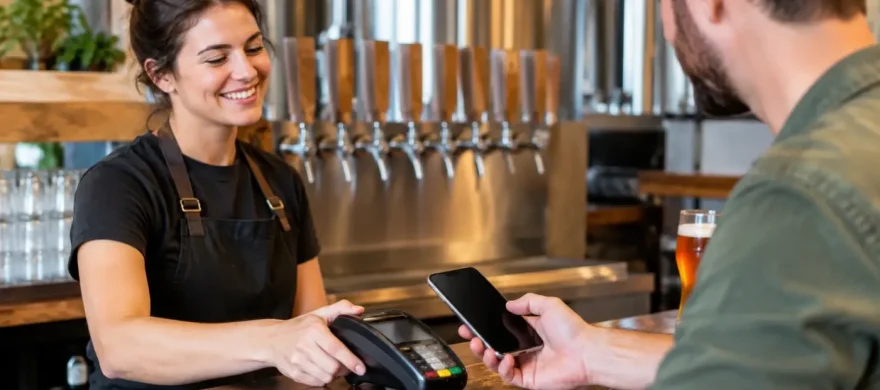
Friday at 6:30 p.m. is a poor time to learn that your card reader has lost its connection, your POS cannot split a check, or your processor has put a deposit on hold. Brewery merchant account options should be evaluated around those real operating moments – not just a low advertised rate. A good setup helps your taproom move a line, protect cash flow, manage tabs, and give your team one less thing to worry about when the room is full.
For breweries, payments are rarely a simple counter transaction. You may have a busy taproom, food service, events, merchandise, mug clubs, gift cards, wholesale invoices, online orders, and a seasonal patio that changes the pace of business overnight. The right merchant account and POS arrangement should support that mix without burying you in confusing fees or forcing staff into workarounds.
What Brewery Merchant Account Options Need to Handle
A merchant account is the relationship that allows your business to accept card payments and receive those funds in your bank account. But the account is only one part of the decision. Your payment processor, POS system, terminals, gateway, reporting tools, and support team all affect what you pay and how smoothly service runs.
For a brewery, the best fit starts with your revenue channels. A taproom focused on bar service needs fast countertop or handheld payments, easy tipping, open tabs, and reliable offline procedures. A brewpub needs restaurant features such as seat-level ordering, split checks, modifiers, kitchen communication, and tip reporting. A production brewery with distribution may also need invoice payments, ACH options, recurring billing, or a payment gateway connected to accounting and order-management tools.
The mistake is choosing a payment provider solely because it is familiar or because the hardware looks simple. That decision can leave you with a system that handles one part of the operation well while creating friction everywhere else.
The Main Brewery Merchant Account Options
There is no single best account for every brewery. The most practical choice depends on your sales volume, service model, existing technology, and how much hands-on support you need.
Integrated POS and payment processing
Many breweries choose an all-in-one POS platform that includes processing, hardware, reporting, and software support. This can be a good option when you are opening a new taproom or replacing an outdated system. The biggest advantage is simplicity: one environment for orders, payments, employee permissions, tips, gift cards, and reports.
The trade-off is flexibility. Some all-in-one systems require you to use their payment processing, and pricing can be difficult to compare if processing rates, software fees, hardware costs, and add-ons appear on separate parts of the bill. Before signing, ask whether you can use another processor later and what happens if your operation outgrows the system.
For a high-volume taproom, test the POS during realistic conditions. Can a bartender start a tab quickly? Can staff split a group check without calling a manager? Does the screen layout make sense when someone is ordering a flight, a pint, food, and merchandise at the same time? The right system reduces touches at the bar instead of adding them.
Standalone merchant account with a compatible POS
A standalone merchant account gives a brewery more room to choose its POS, payment terminals, and gateway. This approach often works well for established operations that want to keep a preferred system or need better control over processing costs.
With this option, the processor handles the card transactions while the POS may come from a separate provider. That separation can create leverage. If service declines or pricing no longer makes sense, you may be able to change processors without replacing the entire front-of-house system.
It also requires more careful planning. Compatibility matters, especially for integrated payments. If your POS and processor do not communicate cleanly, staff may have to enter totals twice, reconcile transactions manually, or deal with inconsistent reporting. Those small delays add up across every shift.
Restaurant-focused processing and POS solutions
A brewpub is not just a brewery with a menu attached. It is a restaurant operation with brewery-specific sales patterns. Restaurant-focused solutions are designed for table service, bar tabs, tipping, kitchen workflows, employee management, and detailed sales reporting.
This category is usually the better fit if food sales are a meaningful part of revenue or if servers handle tables, patios, private parties, and large groups. Look closely at handheld ordering and payment devices. They can improve table turns and reduce the number of steps between taking an order and closing a check, but only when the devices are reliable and the workflow is easy to train.
Do not assume every restaurant POS handles brewery needs equally well. Confirm that it supports age-verification prompts if needed, flight and tasting modifiers, merchandise inventory, gift cards, and separate reporting for food, beer, events, and retail sales.
Mobile and event payment solutions
Festivals, beer releases, farmers markets, off-site catering, and community events can produce strong revenue in a short window. Mobile card readers and wireless terminals are useful for these environments, particularly when you need to accept tap-to-pay and digital wallets away from the main bar.
The concern is connectivity. A mobile solution is only helpful if it keeps working where you sell. Ask about cellular backup, offline transaction procedures, battery life, and how quickly funds settle after an event. You should also know who is responsible if an offline transaction is later declined.
For occasional events, a mobile setup may be all you need. For a brewery that regularly pours at large festivals, a more durable wireless terminal setup and a clear reconciliation process are usually worth the investment.
Online, invoice, and recurring payment tools
Taproom payments are only part of the picture for many breweries. Online merchandise, mug club renewals, private-event deposits, wholesale invoices, and subscription-style releases can all require a payment gateway or virtual terminal.
A payment gateway allows customers to pay through an online checkout or secure invoice. A virtual terminal allows authorized staff to take a payment by phone or enter a card for a deposit. Recurring billing can help with club memberships or installment arrangements, provided customers are clearly informed and your policies are documented.
These tools should match your accounting process. If online sales, deposits, and in-person transactions land in unrelated reports, month-end reconciliation becomes harder than it needs to be. A practical setup gives you clear reporting by sales channel without making your bookkeeper chase deposits across multiple portals.
Compare the Full Cost, Not Just the Rate
Processing statements can be difficult to read by design. A low qualified rate means little if the account includes a high monthly fee, PCI fee, batch fee, gateway fee, statement fee, annual fee, equipment lease, or marked-up interchange costs.
Start by reviewing your effective rate: total processing fees divided by total card sales. This gives you a more useful picture than one advertised percentage. Then separate the costs you can control from the costs you cannot. Card-brand and interchange expenses are set by the payment ecosystem. Processor markup, account fees, equipment pricing, and contract terms are where comparison matters most.
Pay attention to debit transactions. Breweries often process many consumer debit cards, especially at the bar. A pricing model that looks attractive for rewards cards may not be the best overall value if it handles debit poorly. The answer depends on your actual card mix, not a generic quote.
Avoid equipment leases unless you fully understand the total obligation. Leasing a terminal or POS device can turn a modest hardware purchase into years of non-cancelable payments. In many cases, buying hardware outright or using clearly priced monthly equipment terms is easier to evaluate.
Questions to Ask Before You Sign
Before choosing among brewery merchant account options, get direct answers about pricing, support, and flexibility. Ask whether rates are interchange-plus or flat-rate, whether there is a contract or early termination fee, and whether hardware is purchased, rented, or leased.
Also ask who answers the phone when a terminal stops working on a Saturday. National support can be perfectly capable, but a hospitality business often benefits from a provider that understands the urgency of a dead payment device during service. Installation, menu setup, staff training, and post-install support should be part of the conversation, not an afterthought.
Finally, ask to see how reporting works before committing. Owners need clean sales and deposit information. Managers need labor, tip, and shift reports. Bartenders need a system that closes tabs correctly and quickly. If the reporting is hard to use, the information will not help you make better decisions.
Choose the Setup That Makes Service Easier
The best payment setup is not necessarily the cheapest line item on paper. It is the one that lowers your total cost while helping your staff serve guests without delays, mistakes, or complicated workarounds. For a small taproom, that may be a streamlined POS with dependable integrated payments. For a growing brewpub, it may mean restaurant-grade tools and handheld devices. For a production brewery, it may mean a flexible merchant account that supports both taproom sales and invoice payments.
Rocky Mountain Credit Card Processing helps Denver-area hospitality businesses compare their current costs, select practical POS technology, and put the right payment tools in place. A statement review and an honest look at your busiest shift can reveal far more than a promotional processing rate ever will.
Before you make a change, map how money moves through your brewery – from the first open tab to the final deposit. The right provider should make that path clearer, less expensive, and easier for your team to manage.