
Our Blog
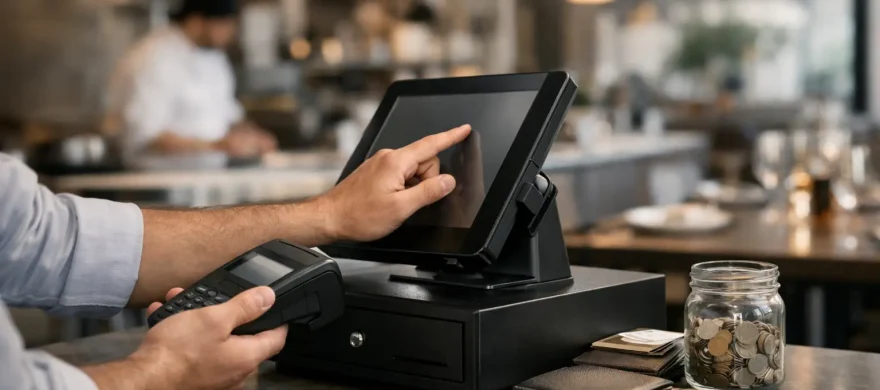
How to Choose Restaurant POS Without Overspending
July 23rd, 2026
A restaurant POS should speed up the shift, not become another problem your manager has to solve at 5:30 p.m. If you are asking how to choose restaurant POS technology, start with the reality of your floor: how orders move, where bottlenecks happen, what your staff needs during a rush, and what you are actually paying to accept cards.
The wrong system can create slow ticket times, confusing reports, surprise monthly charges, and a support line that does not answer when Saturday dinner service is on the line. The right one gives your team a clear workflow, gives you usable information, and helps control payment costs without forcing your business into a complicated contract.
Start With Your Restaurant’s Service Model
A POS system that works well for a quick-service counter may frustrate a full-service dining room. Before comparing screens, hardware, or software packages, define how your restaurant runs on its busiest day.
For a fast-casual restaurant, counter ordering, customer-facing payment, kitchen routing, and quick order modifications may be the priority. A full-service restaurant usually needs table maps, seat positions, split checks, coursing, bar tabs, and handheld devices that let servers take payment at the table. Bars and breweries may care most about fast tab management, age verification prompts, open checks, and the ability to handle a busy rush with minimal touches.
There is no universal “best” restaurant POS. A feature is only valuable when it solves a real operational issue. Paying for advanced reservation tools, delivery integrations, or inventory modules you will not use adds cost and makes training harder.
Map the Order From Guest to Kitchen
Walk through a normal order from the moment a guest arrives to the moment the payment settles. Ask where orders are entered, where they print or display, who can make changes, and where mistakes tend to occur.
If servers regularly walk back to a fixed terminal to enter orders, handheld POS devices may improve table turns and reduce errors. If your kitchen loses paper tickets or modifiers get missed, a kitchen display system may be worth more than another front-of-house terminal. If customers frequently split checks, test that workflow in person instead of assuming every system handles it the same way.
Put Ease of Use Ahead of a Long Feature List
Restaurant teams have turnover. New hires need to learn the POS quickly, and experienced staff need to use it without stopping to hunt through menus. A clean interface matters because every extra tap adds time during a rush.
Ask for a live demonstration based on your actual menu. Have the provider ring up a common order with modifiers, send it to the appropriate kitchen station, move it to another table, split it three ways, apply a discount, and close it with a tip. If the process feels awkward in a demo, it will feel worse with a line at the door.
Also consider manager controls. Owners need visibility, but employees should only be able to perform the tasks their role requires. Look for easy permission settings for voids, discounts, cash drawer access, refunds, and timeclock edits. These controls help prevent avoidable losses without slowing down trustworthy employees.
Evaluate Hardware for the Way You Work
Hardware should fit the layout and pace of your operation. Counter-service restaurants may need a durable main terminal, a customer-facing display, a receipt printer, and a cash drawer. Full-service operations may need stationary terminals plus enough handhelds for servers during peak periods. Kitchens may need protected screens or printers designed for heat, spills, and constant use.
Do not buy hardware based on the lowest upfront price alone. Cheap equipment that fails, has a weak battery, or cannot be replaced quickly becomes expensive when it interrupts service. Ask whether hardware is purchased, leased, or included in a placement program, what the warranty covers, and how replacement equipment is handled.
Internet reliability deserves the same attention. Confirm whether the POS can continue taking orders or payments during an outage, what functions work in offline mode, and how transactions are protected once the connection returns. A backup internet option can be a smart investment for restaurants that cannot afford to stop processing cards.
Look Closely at Payment Processing Costs
POS software and credit card processing are often bundled together, which can make pricing harder to understand. A low monthly software price may be offset by higher processing rates, added compliance fees, statement fees, gateway charges, or contract penalties.
Before signing, request a complete pricing review. You should understand the rate structure, per-transaction fees, monthly charges, equipment costs, chargeback fees, PCI-related fees, and the length of any agreement. If a provider says rates are “starting at” a certain number, ask what your typical restaurant transaction mix will actually cost.
This is particularly important for restaurants because tips, card-present transactions, online orders, and keyed-in payments can all affect effective processing costs. Compare the total monthly cost, not one advertised rate. A statement analysis can reveal charges that are easy to overlook and show whether a proposed POS arrangement will truly save money.
Avoid Contracts That Limit Your Options
Some providers make it difficult or costly to leave. Watch for automatic renewals, early termination fees, noncancelable equipment leases, and proprietary hardware that cannot be used with another processor.
A longer agreement is not always a bad deal if pricing, service, and equipment terms are genuinely favorable. But you should know exactly what you are committing to. Get the cancellation terms in writing and ask who owns the data, menu configuration, customer information, and hardware if you switch providers later.
Make Sure Your POS Connects Where It Counts
A restaurant POS does not have to connect to every app on the market. It does need to work reliably with the tools you depend on. That may include online ordering, delivery platforms, payroll, accounting software, loyalty programs, gift cards, reservations, inventory, or employee scheduling.
Integrations can reduce duplicate entry and make reporting cleaner, but they can also introduce additional subscriptions and support complications. Find out whether an integration is native or managed through a third party. Ask who supports the issue if an order does not reach the kitchen or sales data does not arrive in your accounting system.
For many independent restaurants, a simpler system with a few reliable connections is better than a crowded technology stack. Choose the integrations that reduce work or improve guest service, then leave the rest alone.
Test Reporting Before You Commit
Reports should help you make decisions, not create homework. At a minimum, your POS should make it easy to see daily sales, sales by category, labor information, payment types, discounts, voids, tips, and employee activity.
Look at the reports on both a desktop and mobile device. Can you quickly see how lunch compared with dinner? Can you identify your strongest-selling menu items and the discounts being used most often? Can your bookkeeper access the information needed for reconciliation without chasing down several systems?
The best reporting setup depends on who will use it. An owner-operator may want a simple daily dashboard. A multi-location group may need more detailed reporting by location, employee, menu category, and time period. Do not let a complicated analytics package distract from the numbers you will actually review.
Treat Installation and Training as Part of the Purchase
A POS system is not finished when the equipment arrives. Menu setup, taxes, modifiers, kitchen routing, payment configuration, hardware installation, and staff training all determine whether launch day goes smoothly.
Ask who handles each part of the implementation. Will someone help build your menu and program table layouts? Is installation done on site? How is staff training handled for servers, bartenders, managers, and kitchen employees? What support is available after hours, on weekends, and during a critical outage?
For Denver-area restaurants, local, hands-on service can make a meaningful difference. Rocky Mountain Credit Card Processing helps restaurant operators evaluate the system, processing setup, implementation needs, and ongoing support as one decision instead of leaving them to coordinate several vendors.
Ask These Questions Before You Sign
Before choosing a provider, get direct answers to the questions that affect your operation and your monthly bill:
- What will my total monthly software, hardware, and processing costs look like based on my current sales?
- Does this system support my service style, including split checks, tabs, modifiers, tips, and kitchen routing?
- What happens if the internet goes down or a terminal fails during service?
- Who provides installation, menu setup, staff training, and after-hours support?
- Are there cancellation fees, equipment lease obligations, automatic renewals, or data ownership restrictions?
A provider that answers clearly is usually easier to work with after the sale. If the pricing or support terms feel vague before you sign, they are unlikely to become clearer later.
The right POS should give your staff fewer obstacles, your guests a better experience, and your business a clearer view of costs and performance. Take the time to test real workflows, review the full payment picture, and choose a partner that will still answer the phone when your restaurant is busy.