
Our Blog
Dual Pricing vs Cash Discount for Your Business
July 11th, 2026
A $40 dinner check can create a surprisingly big decision at the register. Do you show one price and offer a discount for cash, or show separate cash and card prices from the start? In the dual pricing vs cash discount conversation, the right answer is not simply the program that moves the most processing cost. It is the one your guests understand, your staff can explain, and your POS can apply correctly every time.
For restaurants, bars, breweries, and retail businesses, payment acceptance is part of the customer experience. A pricing program that looks unclear on a menu, receipt, shelf tag, or checkout screen can create more friction than the savings are worth. On the other hand, continuing to absorb every card processing cost without reviewing alternatives can put serious pressure on already-thin margins.
Dual Pricing vs Cash Discount: The Core Difference
The two approaches can look similar because each gives customers an incentive to pay with cash. The difference is the price you establish and how you communicate it.
How dual pricing works
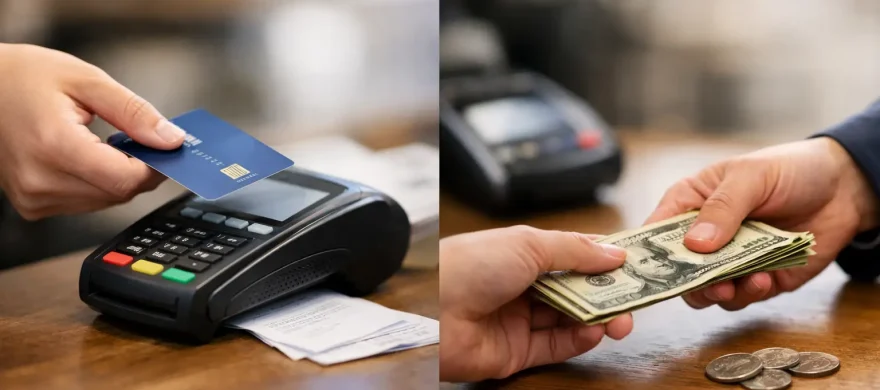
Dual pricing presents two clear prices: a cash price and a card price. A restaurant may list a cash price of $20.00 and a card price of $20.70. A retailer may show both prices on a shelf label or at the register. The customer sees the difference before choosing how to pay.
This approach is often easier for customers to understand because the card price is visible upfront. It can also make the transaction easier for staff to explain: cash costs one amount, a card costs another. The exact presentation matters, though. If the card price only appears after a guest has ordered, or if signage is hard to find, the program can feel like an unexpected fee rather than transparent pricing.
How a cash discount works
A cash discount program begins with one posted standard price, then reduces that price when a customer pays with cash. For example, an item may be listed at $20.70, with a stated cash discount that brings the final total to $20.00.
The distinction may sound technical, but it affects how prices are displayed in your POS, on menus, at the counter, and on receipts. A true cash discount should be set up as a discount for cash payment, not as a last-minute card fee described with different language. The terminology, disclosures, and system configuration need to match the program you are actually running.
Why the Difference Matters to Your Business
Your guests notice price surprises faster than they notice your processing savings. A regular customer may accept a clearly posted card price without much thought. That same customer may push back if an added amount appears only after their card is already in hand.
Dual pricing can be the more straightforward customer-facing model when you want to display the choice clearly before payment. It works particularly well for counter-service restaurants, bars, quick-service concepts, and retail locations where customers see pricing before checkout.
Cash discounts can make sense when your business already has a standard price structure that is easy to communicate and your customer base uses cash often enough to respond to the incentive. But a cash discount does not automatically create a better experience. If the posted price is higher than what guests expect, they may see the cash price as the real price and the card price as a penalty.
There is also an operational issue. A busy bartender or cashier should not have to calculate anything manually or debate policy with customers during a rush. The POS should recognize the payment type and apply the correct amount automatically. Your staff should only need a simple, consistent explanation.
Start With Your Customer, Not Just Your Processing Statement
A processing statement tells you what card acceptance costs. It does not tell you how your customers will react to a pricing change. Before choosing a model, look at the way people actually pay and move through your business.
A brewery taproom with a loyal local crowd, visible menu boards, and a meaningful number of cash transactions may be able to make dual pricing easy to understand. A full-service restaurant with reservations, changing menu prices, split checks, and guests who expect an effortless closeout may need a more careful rollout. A high-ticket retailer may find that a small percentage difference feels more noticeable to a customer making a larger purchase.
Consider these practical questions before making a decision:
- Do customers see your pricing before they order or reach the register?
- Can your menu, shelf labels, website, and checkout display present the policy consistently?
- Does your POS support the program without manual workarounds?
- Will cash handling, change needs, deposits, and employee accountability offset some of the expected savings?
- How likely is a pricing complaint to affect repeat business, reviews, or tip behavior?
The answer may differ by location, concept, average ticket, and customer base. A solution that works well at a fast-casual counter does not always translate cleanly to a white-tablecloth dining room.
Do the Math Beyond the Advertised Rate
When owners evaluate a cash discount or dual pricing program, the headline savings number is usually the first thing they see. It should not be the last number they review.
Start with your actual card volume, effective processing rate, average ticket, debit versus credit mix, and the fees already included in your statement. Then look at the full operational cost of encouraging cash. More cash can mean more drawer counts, more change orders, more frequent bank deposits, greater security exposure, and tighter shift controls.
You should also account for the effect on sales. If customers reduce spending, abandon a purchase, or choose not to return because the pricing feels confusing, the savings may not hold up. That does not mean a pricing program is a bad idea. It means the program should be measured against profit and customer retention, not processing fees alone.
For hospitality operators, tipping deserves special attention. Your POS setup should make it clear how tips are calculated and reported when different payment methods produce different totals. Employees need confidence that the system is handling the transaction correctly, especially when they are closing out tabs during a busy service.
Compliance and Disclosure Are Not Optional
Card brand rules, state requirements, and payment program rules can affect how these programs must be presented. Requirements can change, and the details depend on whether you are using a cash discount, dual pricing, or a surcharge model. These are not interchangeable labels.
Clear disclosure is the practical starting point. Customers should be able to see the applicable price or discount before they pay. Signs should be visible at the entrance or point of sale where appropriate, and the receipt should accurately reflect the transaction. Menus, online ordering, invoices, and self-service kiosks should not tell a different story than the register.
Your processor and POS provider should also confirm that the configuration matches the intended program. A poorly configured system can create receipt language, tax calculations, refund issues, or reporting problems that are difficult to untangle later. If you operate across states, sell online, or have a more complex business structure, get qualified legal and tax guidance before launching.
Roll It Out Without Making Checkout Harder
A good rollout begins before the first sign goes up. Test the program in your POS using real scenarios: a cash sale, a credit sale, a debit sale, a refund, a split tender transaction, a gift card purchase, and a tipped transaction. Verify what staff sees, what the customer sees, and what prints on the receipt.
Then give employees a short script. They do not need a lesson on interchange rates. They need to be able to say, calmly and accurately, “We offer a cash price and a card price, both posted here,” or “The posted price includes a cash discount when you pay with cash.” Keep the explanation factual. Staff should never sound defensive or surprised by the policy.
Monitor the first few weeks closely. Track processing expense, cash volume, refunds, voids, customer comments, and average ticket size. Ask managers what questions are coming up at checkout. If guests are consistently confused, the problem may be your signage or POS flow, not the program itself.
Choose a Program You Can Support Every Day
Dual pricing is often the better fit when visible, upfront price choice matches the way your customers shop or order. A cash discount can work when your business can clearly establish a standard price and apply a real discount for cash. Neither approach is automatically right for every operator.
The best decision starts with an honest look at your statement, customer habits, and POS capabilities. Rocky Mountain Credit Card Processing helps Denver-area businesses evaluate those moving pieces, set up technology correctly, and avoid solutions that save a few cents while creating a new operational headache.
A payment policy should make your margins more manageable without making a guest feel managed. If you can explain it clearly before the card comes out, train your team in one sentence, and see the results in your reports, you are on the right track.